
seen @ The Rubin Museum of Art, New York NY
4.20.12
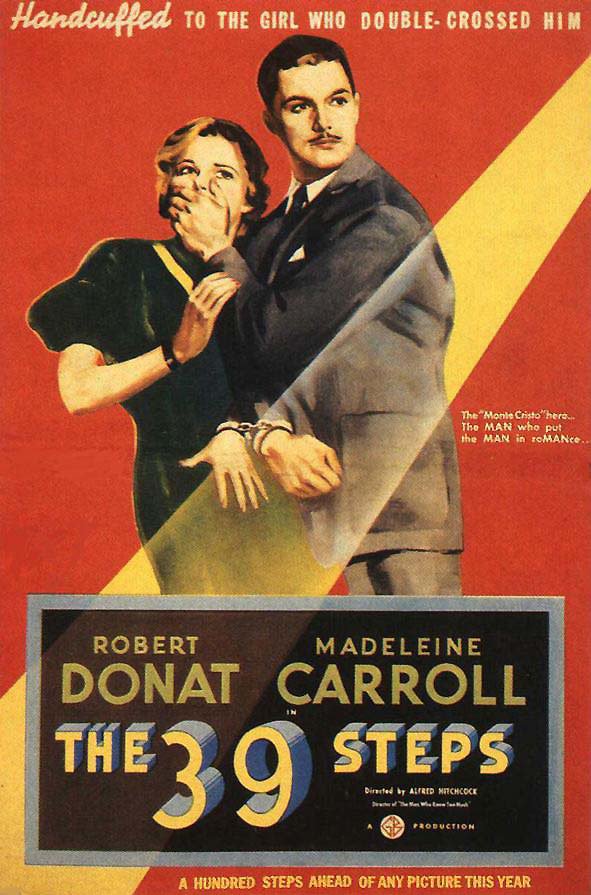
Before Alfred Hitchcock came to America and Hollywood, he had a thriving career in the British film industry. He started out in the London branch of what would become Paramount as a title card designer, after a brief stint writing short stories for a local magazine. From there, he moved on to Islington Studios in 1920, working in the same capacity. He learned the ropes of filmmaking, eventually becoming an assistant director. Influenced by German directors F.W. Murnau and Fritz Lang, his directorial debut was Number 13 in 1923, which suffered financial difficulty and went unfinished. His first successful film was The Lodger: A Story of the London Fog in 1927, one in which he began to develop his personal tropes that would reverberate throughout his career, such as the "wrong man" premise. His first sound picture was 1929's Blackmail, one of the first British talkies. Among his subsequent British films included the original The Man Who Knew Too Much (1934), The Lady Vanishes (1938) and 1935's The 39 Steps.
Steps is one of the first Hitchcock films to use what he called a "Macguffin," an object meant to spur the plot along but is ultimately unimportant. The story he always told to explain what it is involves two men on a train. One explains that he's carrying a Macguffin, a device used to catch lions in the Scottish highlands. When informed that there are no lions there, he replies, "Well then, that's no Macguffin." The Macguffin in Steps is a pilfered set of design plans.

There are other familiar Hitchcock tropes in the movie: man get accused of a crime he didn't commit and is forced to go on the run, relying only on his wits; unlikely partnership with blonde chick added at no extra cost. There's quite a bit of humor in this one, though I'd stop short of calling it a comedy. Some of the situations Robert Donat finds himself in - for instance, when he's mistaken for a politician and has to give a speech to a room full of people - are situations I could imagine happening to, say, Cary Grant in a Hitchcock film. Though Hitchcock is revered as the "master of suspense," he also had a lively sense of humor. Watching a movie like Steps, it seems as if Hitchcock knew the improbability of the dilemma he has put his protagonist in and keeps the story light as a consequence.
Steps has some beautiful location shots of the Scottish countryside. In black and white, one doesn't quite get the full majesty of it all, especially with the overcast skies and fog, but it's still thrilling to see Donat running through the rocky terrain with the cops on his tail.
I saw Steps as part of a series at Manhattan's Rubin Museum of Art, in which the theme was the use of memory in movies. Steps begins and ends with a character who entertains audiences with his ability to memorize and recall random facts at will. The way he figures into the plot is a clever one, and indeed, it hinges on Donat's character's memory: the way one bit of information, seemingly unconnected to anything, can actually be an unconscious link in a chain of memory.

This was my first time at the Rubin, a place recommended to me by my new friend Sylvia, whom I met at another one of Vija's fabulous parties (it's amazing how many people I've met this way). The theater at the Rubin is small, but cozy: low ceiling in the back opening up at the front, soft lighting, comfortable chairs, and candle-lit tables too. The host was this British dude who introduced author James Gleick, who spoke about Steps in the context of how memory figures in the plot.
The set-up for admission was a bit unusual. The Rubin stays open later than usual on Friday nights to show movies, and when I got there I was directed to the lounge, where I had to buy something from the over-priced bar so I could get a ticket to the show. I immediately looked for whatever was the cheapest thing on the menu, but they were serving Indian and Nepalese food, in keeping with a current exhibit, and I'm not that familiar with either, especially the latter. I might've been willing to try some, except it was ten minutes to showtime and I didn't want to have to wait for however long it took to make. Then the guy next to me at the bar said all I needed to do was get a beer and that would be enough to get in, so I did. I bought an $8 Heineken, which is about the price of a matinee movie ticket in Queens or Brooklyn, so it worked out somehow, I guess.
Before Alfred Hitchcock came to America and Hollywood, he had a thriving career in the British film industry. He started out in the London branch of what would become Paramount as a title card designer, after a brief stint writing short stories for a local magazine. From there, he moved on to Islington Studios in 1920, working in the same capacity. He learned the ropes of filmmaking, eventually becoming an assistant director. Influenced by German directors F.W. Murnau and Fritz Lang, his directorial debut was Number 13 in 1923, which suffered financial difficulty and went unfinished. His first successful film was The Lodger: A Story of the London Fog in 1927, one in which he began to develop his personal tropes that would reverberate throughout his career, such as the "wrong man" premise. His first sound picture was 1929's Blackmail, one of the first British talkies. Among his subsequent British films included the original The Man Who Knew Too Much (1934), The Lady Vanishes (1938) and 1935's The 39 Steps.
Steps is one of the first Hitchcock films to use what he called a "Macguffin," an object meant to spur the plot along but is ultimately unimportant. The story he always told to explain what it is involves two men on a train. One explains that he's carrying a Macguffin, a device used to catch lions in the Scottish highlands. When informed that there are no lions there, he replies, "Well then, that's no Macguffin." The Macguffin in Steps is a pilfered set of design plans.

There are other familiar Hitchcock tropes in the movie: man get accused of a crime he didn't commit and is forced to go on the run, relying only on his wits; unlikely partnership with blonde chick added at no extra cost. There's quite a bit of humor in this one, though I'd stop short of calling it a comedy. Some of the situations Robert Donat finds himself in - for instance, when he's mistaken for a politician and has to give a speech to a room full of people - are situations I could imagine happening to, say, Cary Grant in a Hitchcock film. Though Hitchcock is revered as the "master of suspense," he also had a lively sense of humor. Watching a movie like Steps, it seems as if Hitchcock knew the improbability of the dilemma he has put his protagonist in and keeps the story light as a consequence.
Steps has some beautiful location shots of the Scottish countryside. In black and white, one doesn't quite get the full majesty of it all, especially with the overcast skies and fog, but it's still thrilling to see Donat running through the rocky terrain with the cops on his tail.
I saw Steps as part of a series at Manhattan's Rubin Museum of Art, in which the theme was the use of memory in movies. Steps begins and ends with a character who entertains audiences with his ability to memorize and recall random facts at will. The way he figures into the plot is a clever one, and indeed, it hinges on Donat's character's memory: the way one bit of information, seemingly unconnected to anything, can actually be an unconscious link in a chain of memory.

This was my first time at the Rubin, a place recommended to me by my new friend Sylvia, whom I met at another one of Vija's fabulous parties (it's amazing how many people I've met this way). The theater at the Rubin is small, but cozy: low ceiling in the back opening up at the front, soft lighting, comfortable chairs, and candle-lit tables too. The host was this British dude who introduced author James Gleick, who spoke about Steps in the context of how memory figures in the plot.
The set-up for admission was a bit unusual. The Rubin stays open later than usual on Friday nights to show movies, and when I got there I was directed to the lounge, where I had to buy something from the over-priced bar so I could get a ticket to the show. I immediately looked for whatever was the cheapest thing on the menu, but they were serving Indian and Nepalese food, in keeping with a current exhibit, and I'm not that familiar with either, especially the latter. I might've been willing to try some, except it was ten minutes to showtime and I didn't want to have to wait for however long it took to make. Then the guy next to me at the bar said all I needed to do was get a beer and that would be enough to get in, so I did. I bought an $8 Heineken, which is about the price of a matinee movie ticket in Queens or Brooklyn, so it worked out somehow, I guess.


